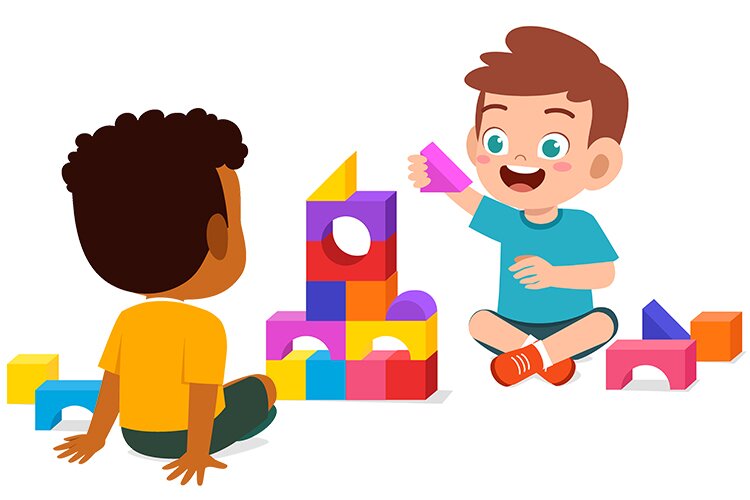
Kindergarteners will celebrate International Lego Day and they will build and overcome an obstacle course made of bricks with their own hands. They will build the tallest towers as they can, design bridges, and make “Which blocks is the tower made of?” worksheets.
Educational aids:
colored boxes filled with blocks, colored sashes, “My doll” song, a globe, “I love my lego” song, “London Bridge Is Falling Down” song, sheets of paper, “Which blocks is the tower made of?” worksheets, pencils/crayons, the song “Toy block play”.
Description of activities:
* Before lessons, for example, while children are eating their breakfast – teacher hides colorful boxes with blocks, in different places in the kindergarten room.
1. ‘When hands meet’ – greeting children – children together with their teacher stand in a circle and, speak and perform the following actions.
When the hands meet,
they immediately greet (shake hands with the person standing to the right)
When thumbs meet,
They immediately greet (each individual touches his thumb with his thumb)
When fingers meet,
They immediately greet (the fingers of one hand touch the fingers of the other hand).
2. “International Lego Day” – introduction to the topic of the day – teacher distributes colored sashes to children (in the same colors as the boxes of blocks hidden in the classroom). Children move around the room to the rhythm of “My doll” song, looking carefully for colored boxes corresponding to the color of their sash. When the music stops, children who have found the boxes, pick them up and bring them to the carpet. Children then join into groups according to the colors of their sashes and then, they can open the boxes. Teacher asks each group what is in the box. Then pointing to the calendar, she/he announces that today, i.e. 28.01, is International Lego Day. Lego originates from Denmark (which she/he points to on the globe) and comes from the words “Let godt” which means “have fun”. The Lego company was founded in 1932 and they initially produced wooden toys. In1940s, it has started to produce the first blocks made of plastic. In turn, teacher asks children what they like to build the most, and which blocks they like to build.
3. “We build” – movement activity – children move around the room to the rhythm of “I love my Lego” song. When the music stops, children are supposed to “build a bridge” as quickly as possible, by standing on the carpet line and holding hands. The activity lasts as long as the song lasts.
4. “Building an obstacle course” – didactic activity – children are divided into groups according to the colors of the sashes. Each team has to build obstacles for an obstacle course. We can assign one type of obstacle to each group, e.g. towers to jump over; high towers connected by a bridge to go under; paths made of blocks to go through with one foot in front of the other; rectangles to jump from one to the other, etc. When all groups have finished their constructions, all children can build an obstacle course.
5. “Overcoming the obstacle course” – movement activity – children line up one by one at the beginning of the track created in the previous activity and then, every child crosses it. The activity is run until all children will overcome the track. Depending on the number of blocks and space in the room, the obstacle course can be left for children to complete later, or you can inform children that they will build a new course after class.
6. “Tower” – didactic activity – children are divided into groups according to the colors of their sashes, and have to build the highest tower possible. Teacher sets a time e.g. 3 minutes/one hourglass. Children start the task with the word: “Start!” and finish when they hear the word “Stop!”. After finishing the task, they compare their towers. The team that will build the highest tower is rewarded with applause.
7. “London Bridge is falling down” – movement activity – teacher chooses two children who face each other, raise their hands and form the bridge. Other children stand in the line and pass underneath the “bridge” singing ‘London Bridge is falling down’ song. When they hear the word “Lady“, the bridge children lower their arms catching one child. Anybody who is caught in their arms replaces one of the bridge children. For the first couple of goes have the children who were caught replace the bridge children, so that everyone has a chance to run around. But later goes the children that get caught are added to the bridge. The activity is repeated until there is just one child left running around – the winner – who is rewarded with applause.
London Bridge is falling down
London Bridge is falling down,
Falling down, falling down.
London Bridge is falling down,
My fair lady.
Build it up with wood and clay,
Wood and clay, wood and clay.
Build it up with wood and clay,
My fair lady.
Wood and clay will wash away,
Wash away, wash away.
Wood and clay will wash away,
My fair lady.
Build it up with bricks and mortar,
Bricks and mortar, bricks and mortar.
Build it up with bricks and mortar,
My fair lady.
(Let’s fix that bridge!)
(Clap your hands!)
Bricks and mortar will not stay,
Will not stay, will not stay.
Bricks and mortar will not stay,
My fair lady.
Build it up with iron and steel,
Iron and steel, iron and steel.
Build it up with iron and steel,
My fair lady.
Iron and steel with bend and bow,
Bend and bow, bend and bow.
Iron and steel will bend and bow,
My fair lady.
Build it up with silver and gold,
Silver and gold, silver and gold.
Build it up with silver and gold,
My fair lady.
London Bridge is falling down,
Falling down, falling down.
London Bridge is falling down,
My fair lady.
8. “Building bridges” – didactic activity – teacher divides children into two groups by counting down to two and asking the “ones” to stand on her/his left and the “twos” to stand on her/his right. Then, teacher hands out the sheets of paper and tells children in teams of ones to sit on one side of the carpet, and children in a team made of twos to sit on the other side of the carpet. Each team has to arrange a bridge on the carpet from the paper sheets adjacent to each other. Teacher informs them that they have to be careful because the carpet is ‘water’, so they can’t go beyond the paper sheets. It is also very important that the bridge of one team cannot touch the bridge of the other team. The activity continues until both teams have finished building their bridges. In the end, children can count how many paper sheets they have used to build their bridges.
9. “Bricklayer” – movement activity – teacher chooses a “bricklayer” who stands in the middle of the carpet. The other children stand on one side of the carpet and at teacher’s signal, e.g. a bell’s sound, they run to the other side of the carpet. “The bricklayer” has to catch children – but he/she can only move in one line – across the width of the carpet, but not back and forward. The child caught by the bricklayer joins him/her. Only those children, who are on the edge of the ‘bricklayer wall’ can catch the running children. The activity continues until there is only one child left on the carpet, who is rewarded with applause.
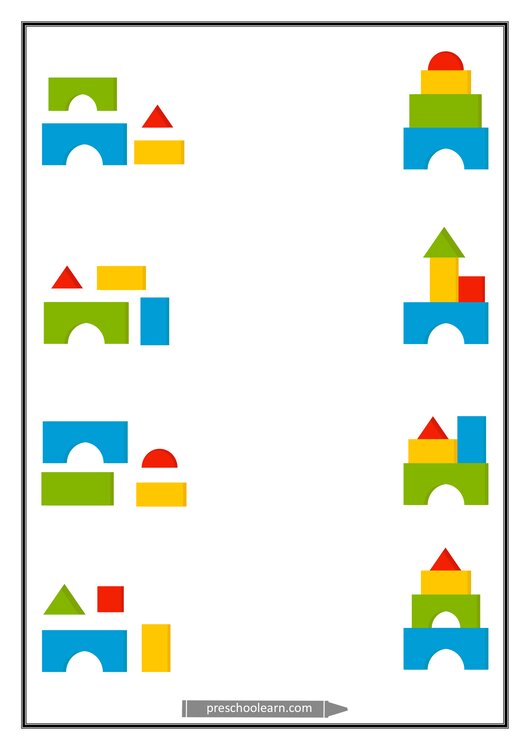
10 .”Which blocks is the tower made of?” – making a worksheet – teacher presents and discusses with children how to complete the task (they have to connect the blocks to the tower, which is built by them). Afterwards, teacher asks children to go the tables and distributes the work cards. When children do their task, teacher goes between the tables, helps children if they need it and checks whether the task is done correctly.
11. “Blocks” – movement activity – children move around the room to the rhythm of “Toy block play” song. When the music stops, they get into groups consisting of as many people as teacher says. The activity is repeated 4-5 times.
Attachments:
“Which blocks is the tower made of?” worksheet
Pages:
- https://www.youtube.com/watch?v=4kGEcfMbgQ4 – “My doll” song
- https://www.youtube.com/watch?v=xXSdtTQ4On4 – “I love my lego” song for the “We build” activity
- https://www.youtube.com/watch?v=xaXCf_fPD2k&ab – ‘London Bridge Is Falling Down’ song for the ‘London Bridge Is Falling Down’ activity
- https://www.youtube.com/watch?v=p6UhZlDM-u4 – “Toy block play” song for the “Blocks” activity